One of the first questions on almost any bulk liquid inquiry is about equipment: should this go in a flexitank, an ISO tank, or IBCs? Each one solves a different problem, and the right answer usually depends on more than the product alone.
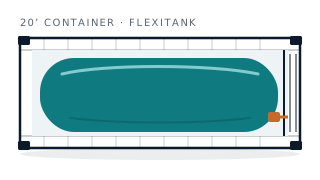
Flexitanks
A flexitank is a large, single-use bladder installed inside a standard 20’ dry container. Once it’s fitted and filled, an ordinary container becomes a bulk liquid carrier.
- Capacity: typically up to about 24,000 litres in a single 20’ container, depending on the product’s weight.
- Strengths: it uses widely available dry containers, and because the bag is single-use there’s no empty tank to send back.
- Limits: flexitanks are generally used for non-hazardous liquids. The container has to be in good condition, and installation and discharge need to be planned.
ISO tanks
An ISO tank is a reusable steel tank mounted inside a frame with the same footprint as a 20’ container, so it moves through ports, vessels and chassis like any other box.
- Capacity: commonly in the range of roughly 17,500 to 26,000 litres, depending on the tank.
- Strengths: suitable for a wide range of products, including many regulated chemicals, with the right tank type. Dedicated food-grade tanks are available, and many tanks can be heated for products that thicken or solidify.
- Limits: tanks need cleaning between loads, and prior-cargo history matters. They usually have to be filled within a set range to limit liquid surge in transit. The empty tank also has to be repositioned after delivery, which affects cost on some lanes.
IBCs and totes
Intermediate bulk containers (IBCs, often called totes) are caged plastic containers on a pallet base, typically holding around 1,000 litres each. They’re loaded into a container or truck like any palletized freight.
- Strengths: flexible for smaller volumes and mixed orders. They’re easy to handle at sites without bulk unloading equipment, and product can often go straight into the customer’s process.
- Limits: more units mean more handling. Regulated products need properly UN-rated IBCs, and stacking and weight limits have to be respected.
Side by side
| Flexitank | ISO tank | IBCs | |
|---|---|---|---|
| Typical volume | Up to ~24,000 L per container | ~17,500–26,000 L | ~1,000 L per unit |
| Reusable | No, single-use | Yes | Depends on the program |
| Hazardous products | Generally no | Yes, with the right tank | Yes, if UN-rated |
| Heating | Possible with heating pads | Common | Limited |
| Empty return | None | Required | Depends |
| Best when | High-volume, non-hazardous, one-way | Regulated, sensitive or heated products | Smaller or mixed volumes |
Questions that usually decide it
- What is the product, exactly? The safety data sheet and classification can rule options in or out immediately.
- How much, and how often? A one-time 20,000-litre move and a monthly program are different conversations.
- Does it need heat, or special cleanliness? Food-grade products, oils and fats each bring their own requirements.
- How does the receiver unload? This is often overlooked. A bulk discharge setup, a pump and hoses, or a forklift for IBCs: the destination’s setup matters as much as the origin’s.
- What does the round trip look like? For ISO tanks, getting the empty tank back is part of the real cost.
Weight often runs out before space does. Liquids are heavy, so container and road weight limits can cap how much you ship well before the equipment is “full.”
This is general information, not technical, legal or regulatory advice. Equipment specifications vary by provider, and every product and lane should be confirmed case by case.